Pull-Off Strength Test for Tile Adhesive, Explained Simply
gresbond
March 27, 2026
The pull-off strength test is how tile adhesive bond strength is actually measured. This post explains the method in plain language, why it matters for kitchens, bathrooms, facades and large-format tiles, and what a tested adhesive gives you on site.
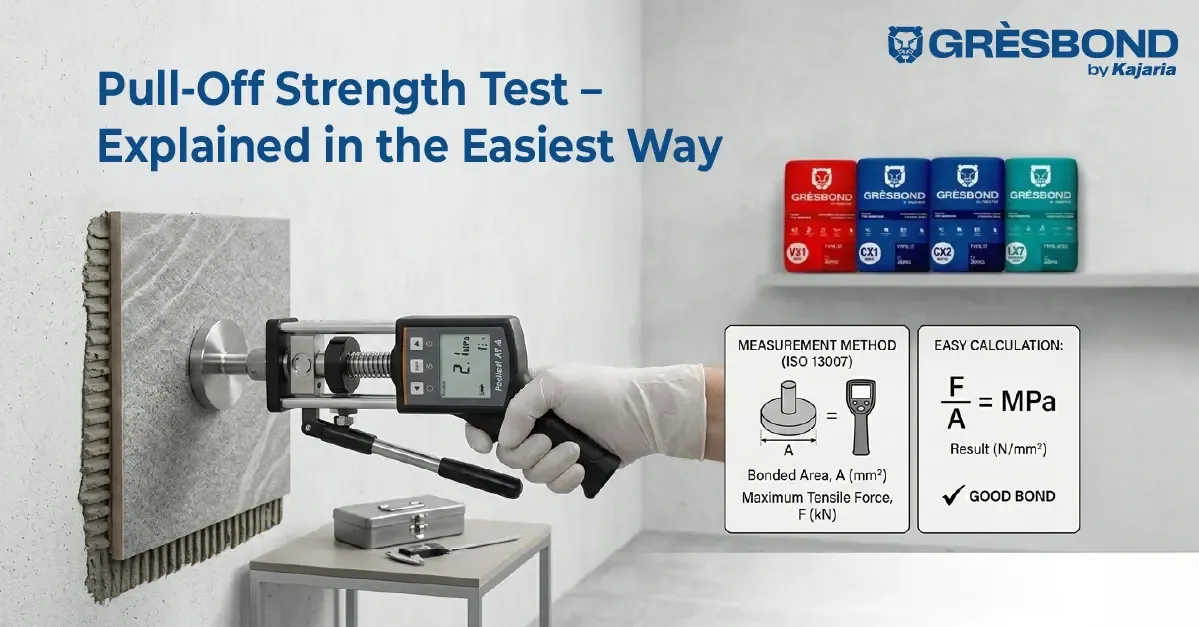
When we fix tiles on a floor or wall, we want them to stay there for a long time. We don’t want tiles coming out, cracking, or making a hollow sound when we walk on them. The thing that keeps tiles in place is the tile adhesive. If the adhesive is strong, the tiles stay firm. If it is weak, tiles can slowly start coming loose. Products like CX-1 or VX-1 are tested to provide this strong bonding.
To check if an adhesive is strong enough, companies use a simple method called the Pull-Off Strength Test. Brands like CX-2 and LX-7 S1 go through this test to ensure durability.
What Is the Pull-Off Strength Test?
The Pull-Off Strength Test checks how strong the bonding is between the tile and the surface below it.
In very simple words, it measures how hard you have to pull to remove the tile.
Here’s how the test is done:
A small metal piece is stuck on the tile using the adhesive.
The adhesive is allowed to dry fully.
A machine pulls the metal piece straight outward.
The machine keeps pulling until the tile or adhesive bond breaks.
The force needed to break it is measured.
Why Is This Test Important?
Tiles face pressure every day.
People walk on them.
Furniture is placed on them.
Bathrooms and kitchens have water and moisture.
Outdoor tiles face heat, rain, and sunlight.
If the adhesive is not strong, problems can happen
Tiles may lift from the surface
Tiles may crack
You may hear hollow sounds
Water may go inside
Repairs may cost more money
Where Is Strong Bonding Needed?
Strong adhesive is needed in many places. In homes, especially kitchens and bathrooms, tiles must handle daily water and cleaning. Products like pua-100 are suitable for wet areas due to their water resistance.
In commercial buildings like malls, offices, and hospitals, many people walk on the floors. The adhesive must be strong to handle heavy use.
In outdoor areas like balconies and terraces, tiles face weather changes. Heat and cold can affect bonding. A strong adhesive helps tiles stay in place.
Today, big and heavy tiles are very common. These tiles need stronger adhesive to stay fixed properly.
How Do Good Brands Test Their Products?
Good companies test their adhesives before selling them. Gresbond by Kajaria uses the Pull-Off Strength Test to check the quality of its products.
A good adhesive should:
Hold tiles tightly
Resist water
Handle temperature changes
Last for many years
Conclusion
The Pull-Off Strength Test may sound like a big technical name, but it is very simple. It checks whether the adhesive is strong enough to hold tiles properly.
When you choose a tested and strong adhesive, you reduce the risk of tiles coming loose. You also avoid future repair costs.
In simple words, strong adhesive means strong and safe tiles. And this test helps make sure the bonding strength is real and long-lasting.
Frequently Asked Questions
It measures how much force is needed to pull a tile away from the surface it is bonded to. A fitting is glued to the tile, the adhesive is left to cure, and a calibrated machine pulls straight outwards until the bond breaks. The force at failure is the pull-off, or tensile adhesion, strength.
Because it is the number behind tiles staying put. Every footstep, furniture load, temperature swing and wetting cycle tries to separate the tile from the substrate. An adhesive with proven pull-off strength holds through that, which is why hollow sounds, lifting edges and cracked joints are far less likely.
Wet areas such as bathrooms, kitchens and pool surrounds; exterior floors, balconies and facades that heat and cool daily; commercial floors with constant traffic; and anywhere large-format or heavy tiles are used, since a bigger tile puts far more load on the bond.
Yes. Dense, low-porosity tiles such as vitrified and porcelain give the adhesive less to key into than porous ceramic, and difficult substrates like metal, plywood or drywall behave differently again. That is why Gresbond offers products matched to each case, from VX-1 for vitrified tiles to PUA-100 for metal and plywood.
Check the technical data sheet for the classification the product carries and the tests behind it. For example, Gresbond EX-5 is classified C2TES1 under ISO 13007 and exceeds IS 15477:2019 Type 3TS1, and LX-7 Super Flex S2 is Type 4TS2 and C2TES2. Those markings mean the bond strength has been measured, not claimed.
Still have questions? Contact our technical team