Why Cheap Tile Adhesives Fail and What They Really Cost You
Gresbond by Kajaria Editorial Team
January 5, 2026
Hollow tiles, cracked grout and lifting corners usually trace back to a low-grade adhesive, not the tile. This post explains how cheap tile adhesives fail under Indian heat and moisture, what repairs cost, and which Gresbond adhesive to choose.
Tile adhesive is not just a material that holds tiles in place. It is the layer that quietly supports everything above it. Every footstep, every change in temperature, and every bit of movement passes through the adhesive first. When the wrong adhesive is used, problems don’t show up immediately. Tiles often look fine at the start. Weeks or months later, small signs appear—hollow sounds, loose edges, cracked grout, or water finding its way below the tiles. No matter how costly or premium the tiles are, a weak base will eventually let them down.
In India, many people choose cheaper tile adhesives to reduce the initial cost of a project. At first, this feels practical. The material is inexpensive, and the work gets done quickly. The issue is that low-cost adhesives usually lack flexibility and proper bonding strength. They struggle with heat, moisture, and seasonal movement. Indian weather puts constant pressure on tile installations, and cheap adhesives slowly lose grip under these conditions.
What seems like saving money early often leads to repeated repairs, tile removal, and damage to the surface underneath. A good-quality tile adhesive costs more upfront, but it holds tiles securely, handles movement better, and lasts for years. In the long run, it saves money, time, and frustration. Choosing the right adhesive is not an upgrade—it is basic protection for your tiles and your structure.
Why Does Tile Adhesive Fail?
Tile adhesive failure almost never comes from one big wrong step. It usually happens when a few small mistakes stack up over time. Maybe the adhesive wasn’t right for that tile or area. Maybe the surface wasn’t cleaned well, or the mix wasn’t done properly. Sometimes heat, moisture, or site conditions are simply ignored. None of this looks serious on day one, so the tiles seem fine after fixing. But slowly, stress starts building underneath. That’s when problems show up—tiles sound hollow, corners loosen, grout cracks, or tiles begin to lift. What felt like a minor shortcut during installation eventually turns into a clear and costly failure.
Common Reasons for Tile Adhesive Failure
Low cement or polymer content
Poor bonding strength
Wrong adhesive selected for the area or tile type
Weather conditions not considered
Improper surface preparation
Cheap adhesives compromise on most of these points. That is where problems begin.
Why Do Tiles Pop Off? Common Reasons Explained
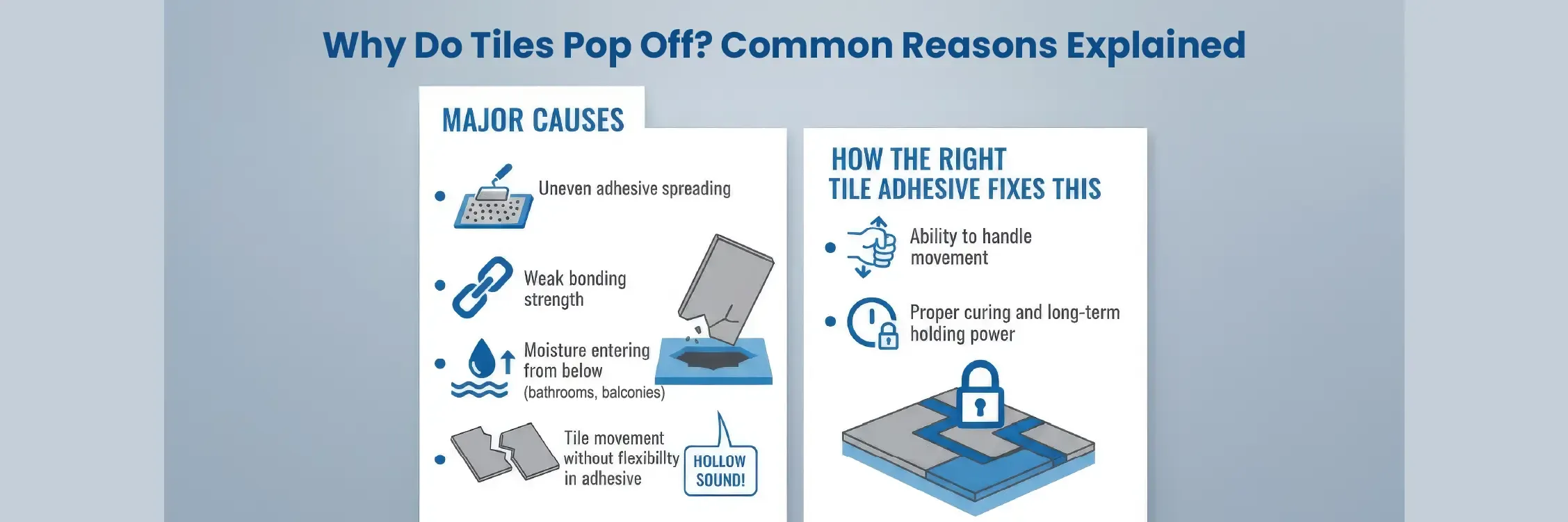
When tiles start popping off or give a hollow sound, it is a clear warning sign.
Major Causes:
Uneven adhesive spreading
Weak bonding strength
Moisture entering from below (bathrooms, balconies)
Tile movement without flexibility in adhesive
How the Right Tile Adhesive Fixes This
Strong initial grip
Ability to handle movement
Proper curing and long-term holding power
A good adhesive does not just stick tiles—it locks them firmly to the surface.
What Is the Lifespan of Tile Adhesive?
Tile Adhesive Life Expectancy
High-quality tile adhesive: 15–25 years
Cheap tile adhesive: 2–5 years (sometimes even less)
Cheap adhesives lose strength over time. Premium adhesives are designed to handle moisture, temperature changes, and daily load for many years.
What Is the Lifespan of Tile Adhesive?
The lifespan of tile adhesive depends largely on its quality and how it is used. A good-quality adhesive, when chosen correctly and applied the right way, can hold tiles securely for many years without trouble. It stays strong under daily use, handles temperature changes, and resists moisture, which helps keep tiles firmly in place over time.
Cheap tile adhesives usually do not last as long. They may seem fine in the beginning, but their strength slowly reduces. Heat, humidity, and regular movement put pressure on the bond, and low-grade adhesives struggle to cope with this. Over time, tiles may start sounding hollow, grout can crack, or tiles may loosen and lift.
This is why adhesive quality matters as much as the tiles themselves. A reliable adhesive supports the tiles quietly in the background, while a poor one leads to early failure. Choosing the right adhesive from the start helps avoid repeated repairs and ensures the installation stays intact for years.
Difference Between Cheap and Premium Tile Adhesives
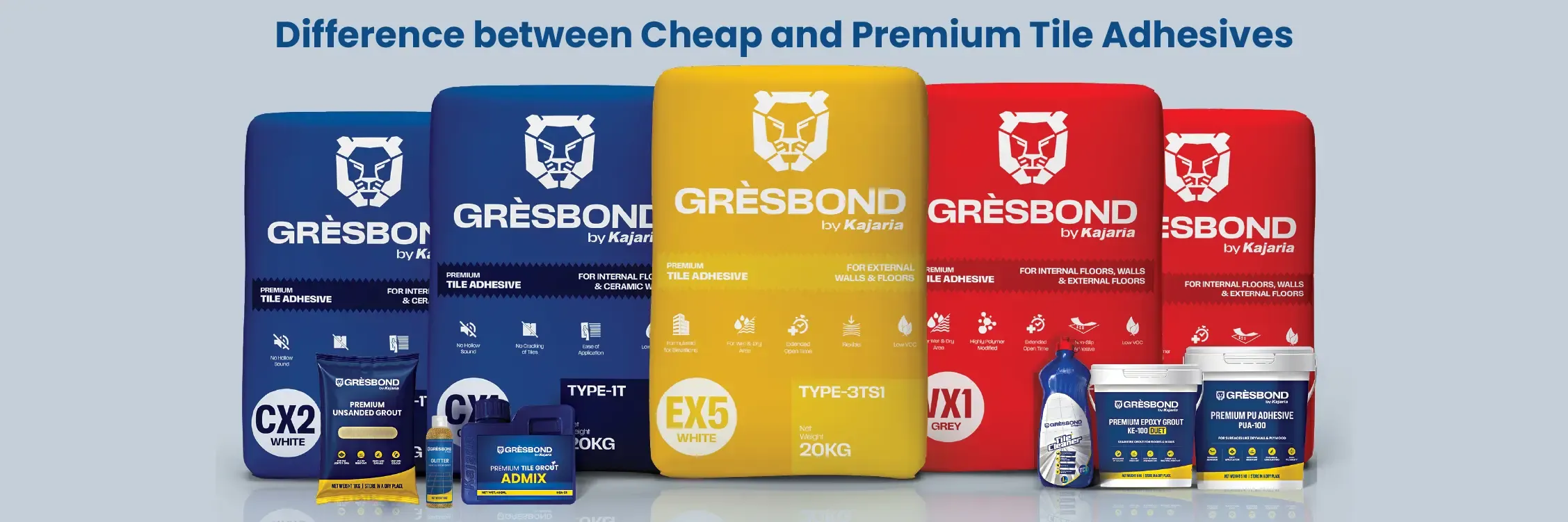
This is not just about price—it is about performance.
Cheap Tile Adhesives:
Low polymer content
Poor flexibility
Weak water resistance
High shrinkage
Frequent tile failures
Premium Tile Adhesives:
Strong bonding strength
Crack resistance
Waterproof and weather-resistant
Better load handling
Long service life
Cheap vs Expensive Tiles
Buying expensive tiles alone is not enough. If the adhesive is weak, even premium tiles will fail.
Common Tile Installation Failures and Their Root Causes
1. Tile Debonding
Cause: Weak adhesive or wrong mixing
2. Hollow Sound
Cause: Incomplete adhesive coverage
3. Cracks in Tiles
Cause: Lack of flexibility in adhesive
4. Tile Lippage
Cause: Slow or uneven setting
Prevention Strategy
Right adhesive + correct application method = long-lasting tiles
How Poor Adhesive Choices Are Silently Eroding Indian Homes
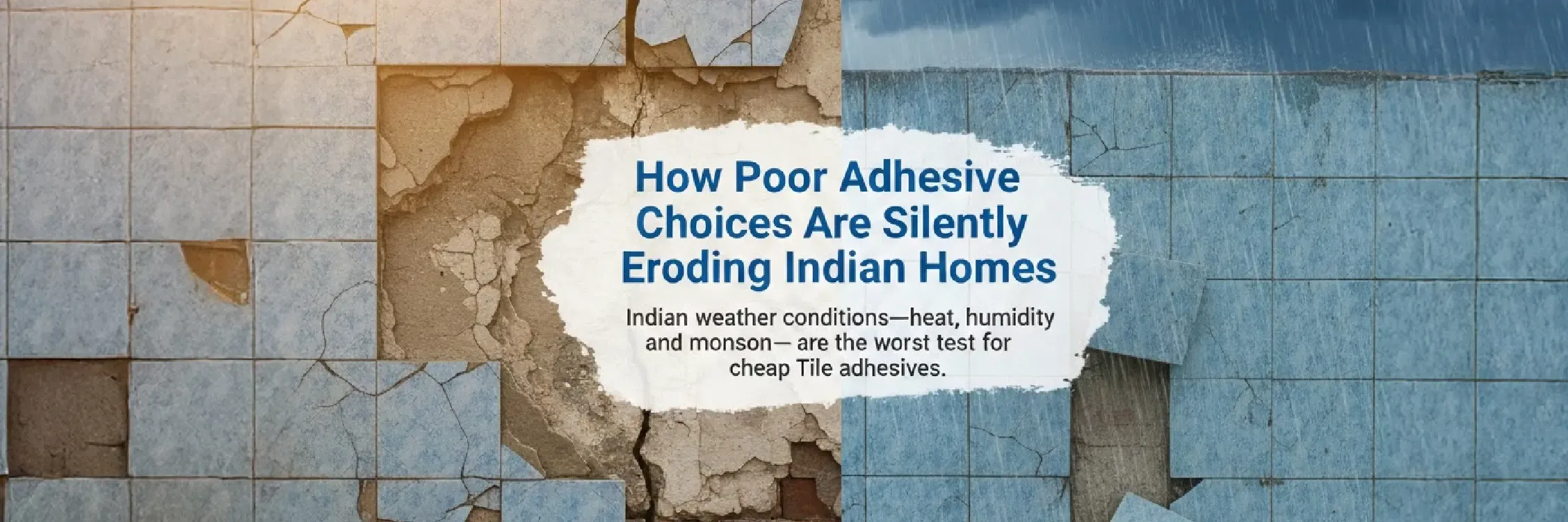
Indian weather conditions—heat, humidity, and monsoon—are the worst test for cheap adhesives.
Absorbs moisture
Slowly loses grip
Gradually separates tiles from the surface
This damage does not show immediately. Over time, it affects floors, walls, and even waterproofing layers.
Understanding Epoxy and Why It’s the Future of Floor Tile Adhesives
Epoxy adhesives are different from cement-based adhesives.
Epoxy Adhesive Features:
Much stronger bonding
High chemical and water resistance
Zero shrinkage
Ideal for heavy-duty areas
Because of these properties, epoxy is widely used in hospitals, commercial kitchens, and industrial floors. For high-performance flooring, epoxy is becoming a strong future option.
Cost-Effectiveness of Tile Adhesives for Home Renovations
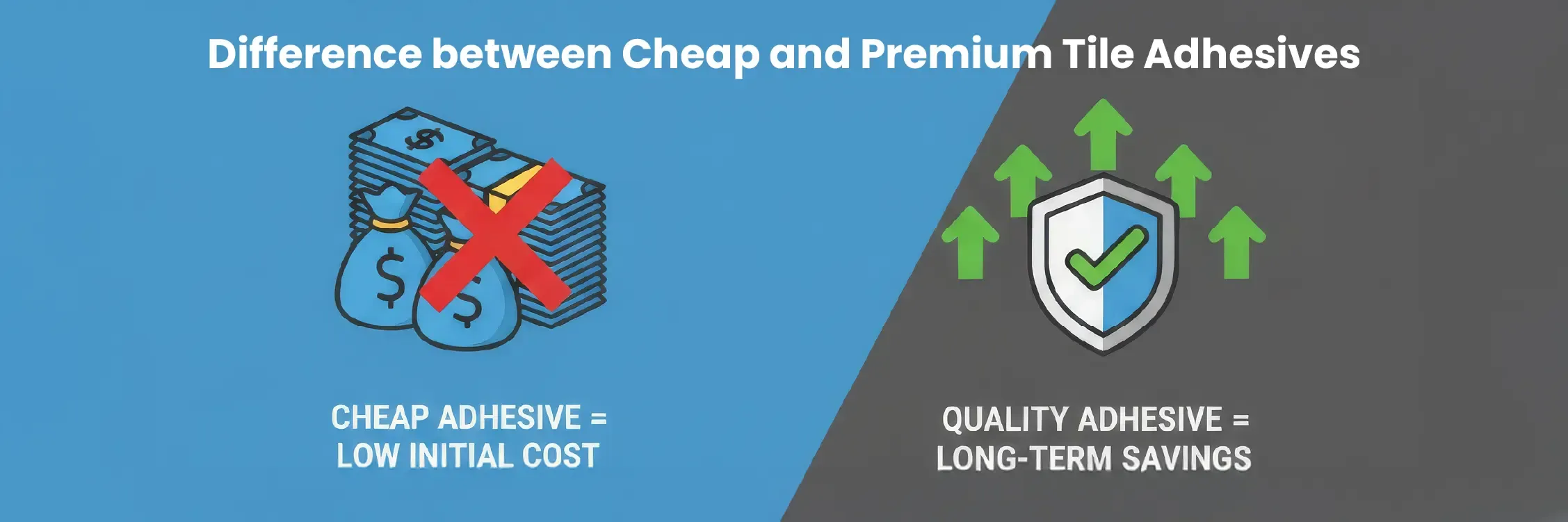
Cheap adhesive = low initial cost
Quality adhesive = long-term savings
Long-Term Cost Comparison:
Cheap adhesive → frequent repairs → higher lifetime cost
Good adhesive → minimal maintenance → real savings
That is why choosing cheap adhesive during renovation is a false economy.
5 Myths Damaging Your Tile Installations
Myth 1: All tile adhesives are the same
Wrong—formulation makes a big difference.
Myth 2: Tiles hold weight, not adhesive
The bond strength comes from the adhesive.
Myth 3: Cement alone is enough
Modern tiles need polymer-based adhesives.
Myth 4: Indoor adhesive works everywhere
Each area needs a specific adhesive type.
Myth 5: Cheap adhesive saves money
In the long run, it costs more.
What Is Tile Adhesive and Why Does It Matter So Much?
Transfers load evenly
Handles movement
Acts as a moisture barrier
Determines tile lifespan
That is why adhesive should not be treated as a supporting product. It is a core material of tile installation.
Tools and Materials That Improve Installation
Using the right products and tools changes everything. High-performance adhesives like vx-1, lx-7, kga-01, and epoxy systems such as ke-100 duet provide stronger bonds and longer life. For application and finishing, tools like rubber mallet, carbide tile grout saw, stll 850 mixer, and tile shaping template help ensure accuracy. You can also estimate material needs using the tile adhesive calculator.
Final Note
Cheap tile adhesive may look like an easy way to save money at the start of a project, but that saving rarely lasts. In the early days, everything appears fine. Tiles sit in place, grout looks clean, and there are no visible issues. Over time, though, the real problems begin to show. Low-quality adhesive often lacks the strength and flexibility needed to handle daily use, temperature changes, and moisture. As months or years pass, the bond slowly weakens. Tiles may start sounding hollow, edges can loosen, grout may crack, and in wet areas, water can seep underneath.
Once these issues appear, fixing them is never simple. A single loose tile often leads to removing surrounding tiles. In many cases, the entire section needs re-tiling. This means extra labour, new materials, and disruption to daily life. What was saved at the beginning is quickly lost through repairs and repeated work.
Choosing the right tile adhesive from the start avoids these problems. A good adhesive holds tiles firmly, absorbs small movements, and stays stable for years. It protects not just the tiles, but also the surface beneath them. In the long run, using a reliable adhesive once is always cheaper and far less stressful than fixing tile failures again and again.
Frequently Asked Questions
Low-cost adhesives usually have less polymer and weaker cement, so the bond is brittle and cannot follow the small movements a floor makes with heat and moisture. The tile looks fine on day one, but the bond slowly lets go, which is why hollow sounds and loose edges appear months later.
Far more than the adhesive saved. One loose tile usually means lifting the tiles around it, chipping out the old bed, buying replacement tiles that may no longer match, paying for labour twice and living with the disruption. In wet areas, water that got behind the tiles can also damage the waterproofing.
Match the adhesive to the tile and the location. For vitrified tiles and exterior floors, Gresbond VX-1 or VX-2; for tile-on-tile and demanding surfaces, EX-5; for large-format slabs, LX-7 S1 or LX-7 Super Flex S2. Check the technical data sheet for the classification and bed thickness before you buy.
It has the same weaknesses, plus a few more. Sand-cement shrinks as it dries and grips poorly on dense vitrified tile backs, so tiles laid on it are the most common source of hollow and popped tiles. A polymer-modified adhesive spreads evenly, bonds to both surfaces and handles movement.
Yes. Even the best adhesive fails if the floor is dusty or uneven, the mix is too wet, the adhesive skins over before the tile is placed, or coverage is patchy. Use a notched trowel, back-butter large tiles, respect the open time on the pack and keep traffic off until it has set.
Still have questions? Contact our technical team