How to Mix Tile Grout: Ratio, Consistency and Setting
Gresbond by Kajaria Editorial Team
November 19, 2026
Most grout failures start in the bucket, not on the floor. This guide covers how to mix tile grout for cement and epoxy types, the water or admix ratio, the consistency to aim for, and the mixing mistakes that leave joints weak or cracked.
A grout joint fails in the bucket long before anyone sees it on the floor. The powder gets too much water, or not enough. The two parts of an epoxy pack get scraped in unevenly. Someone adds a splash of water to loosen a mix that has started to stiffen. None of it shows at the time. It shows three months later, when the joints powder at the edges or wash out in the first proper clean.
So learning to mix tile grout properly is the step that decides whether the joint lasts. It sounds basic. It is where most of the damage is done. Cement grout and epoxy grout mix in completely different ways, and treating one like the other is the fastest route to a weak joint. Here is how to mix tile grout correctly for each type, the ratio and consistency to aim for, and the errors that quietly ruin a floor.
Key Takeaways
- Cement and epoxy grout mix differently. One takes water or admix, the other does not.
- Cement grout mixes at roughly 375 to 400 ml of water or admix per 1 kg of powder (check the bag).
- Epoxy grout mixes without water. Two liquid parts, then a filler powder.
- Aim for smooth and stiff, not loose. A runny mix is a weak joint.
- Never re-temper a mix that has started to set by adding more water.
- Mix only what you can use inside the working window.
- A grout admix replaces water, not adds to it, for a denser joint.
Why how you mix tile grout decides the joint
The joint is the weakest line in any tiled surface. It takes the water, the dirt, the cleaning chemicals and the foot traffic, while the tile face shrugs all of it off. So the joint has to be made right, and that starts at the mix.
Get the ratio wrong and the failure is built in. Too much water and the cement matrix sets porous and weak, which is what causes powdering and colour loss later. Too little and the grout will not pack into the joint. That leaves voids, and voids fail first. Our guide on why tile gap filling matters covers what the joint is doing structurally.
There is a second decision before you even open the bag. Which grout are you mixing? Cement grout and epoxy grout are different products with different chemistry. The mixing method is not interchangeable. Our comparison of epoxy grout and cement grout covers which to pick, and the types of tile joint filler guide covers the full range.
How to mix tile grout: cement grout
Cement grout is the one most people picture. A powder, mixed with liquid, worked into the joint. It is the standard choice for narrow joints on floors and walls, and it mixes the way most people expect.
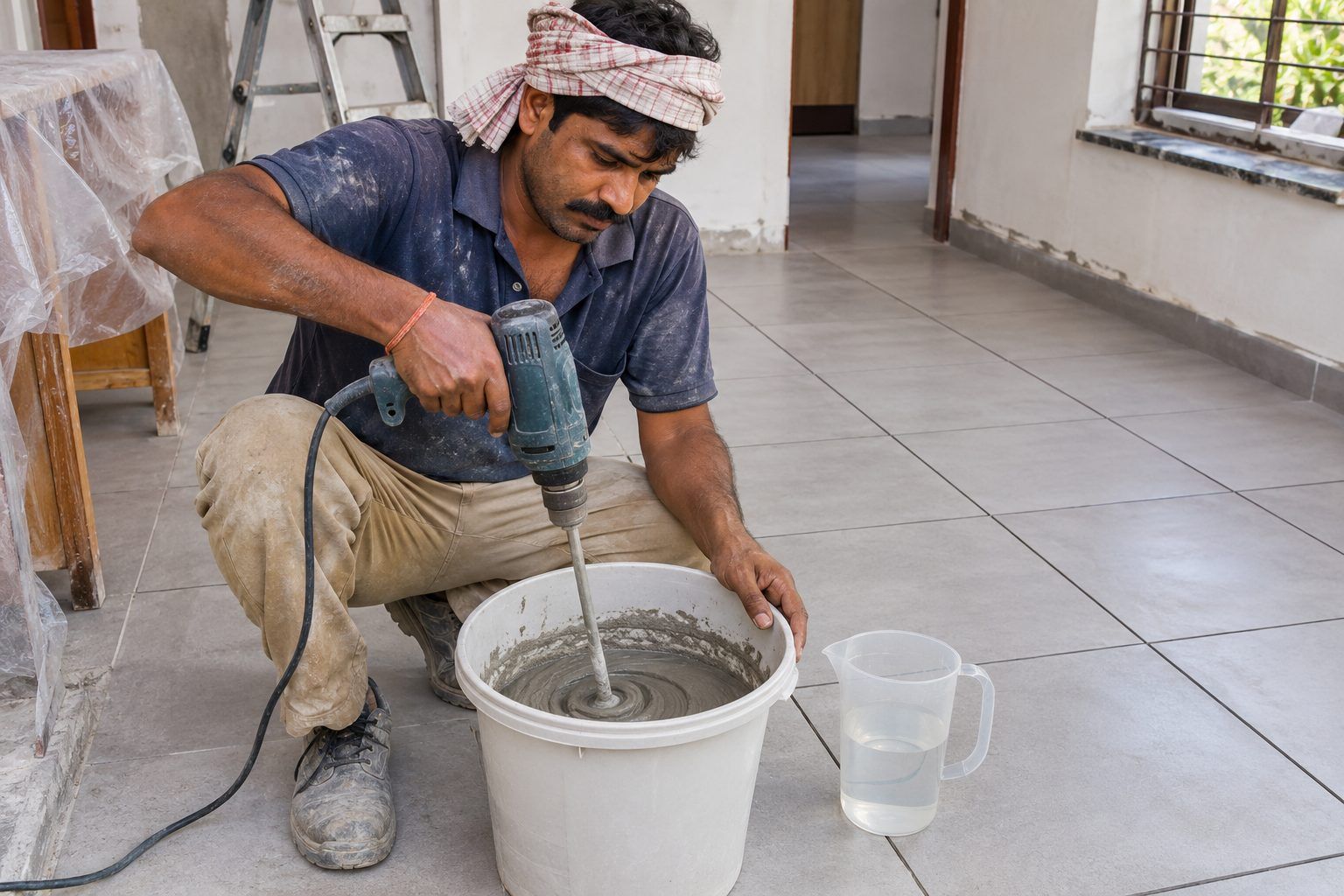
The ratio matters more than anything else here. Cement grout is mixed with a set amount of liquid per kilogram of powder, and the exact figure is printed on the bag. For Gresbond's cement grout it is 375 to 400 ml per kilogram. Measure it. Pouring liquid by eye is how two batches on the same floor end up slightly different shades, because the water content changes how the colour sets.
Add the powder to the liquid, not the other way round. Tipping liquid onto a heap of powder traps dry pockets that never mix out properly. Then mix by hand or with a slow-speed mixer. Work it until the grout is smooth and stiff. Stiff is the word to hold onto. The mix should hold its shape, not run off the trowel.
Cement grouts state a substrate temperature range, and Gresbond's cement grout states 16 to 32 degrees Celsius. Outside the stated band the grout sets differently. A cold morning or a hot afternoon both work against you. Check the figure on your bag.
How to mix tile grout: epoxy grout
Epoxy grout does not touch water, and this is where people trip up. An epoxy grout is a multi-part system, not a powder you wet. It comes as two liquid components plus a filler powder, and they have to be combined in a set order.
Pour the two liquid parts into a clean container and mix them first. These are the resin and the hardener, proportioned for each other, so both have to go in fully. Then add the filler powder slowly while mixing, and stop once the grout is smooth, uniform and lump-free. Do not add water to loosen it. Water has no place in an epoxy mix and will wreck the cure.
Scrape the sides and the base of the container as you go. Any unmixed material that rides into a joint stays soft and never properly hardens. This is a common reason an epoxy joint stays tacky weeks later.
Epoxy is less forgiving on time than cement, so mix only what the team can place and clean before it stiffens. Our epoxy grouting guide covers the application and cleaning window in detail.
The right grout consistency, and how to judge it
Smooth and stiff. That is the target for a cement grout, and it is worth knowing what it feels like.
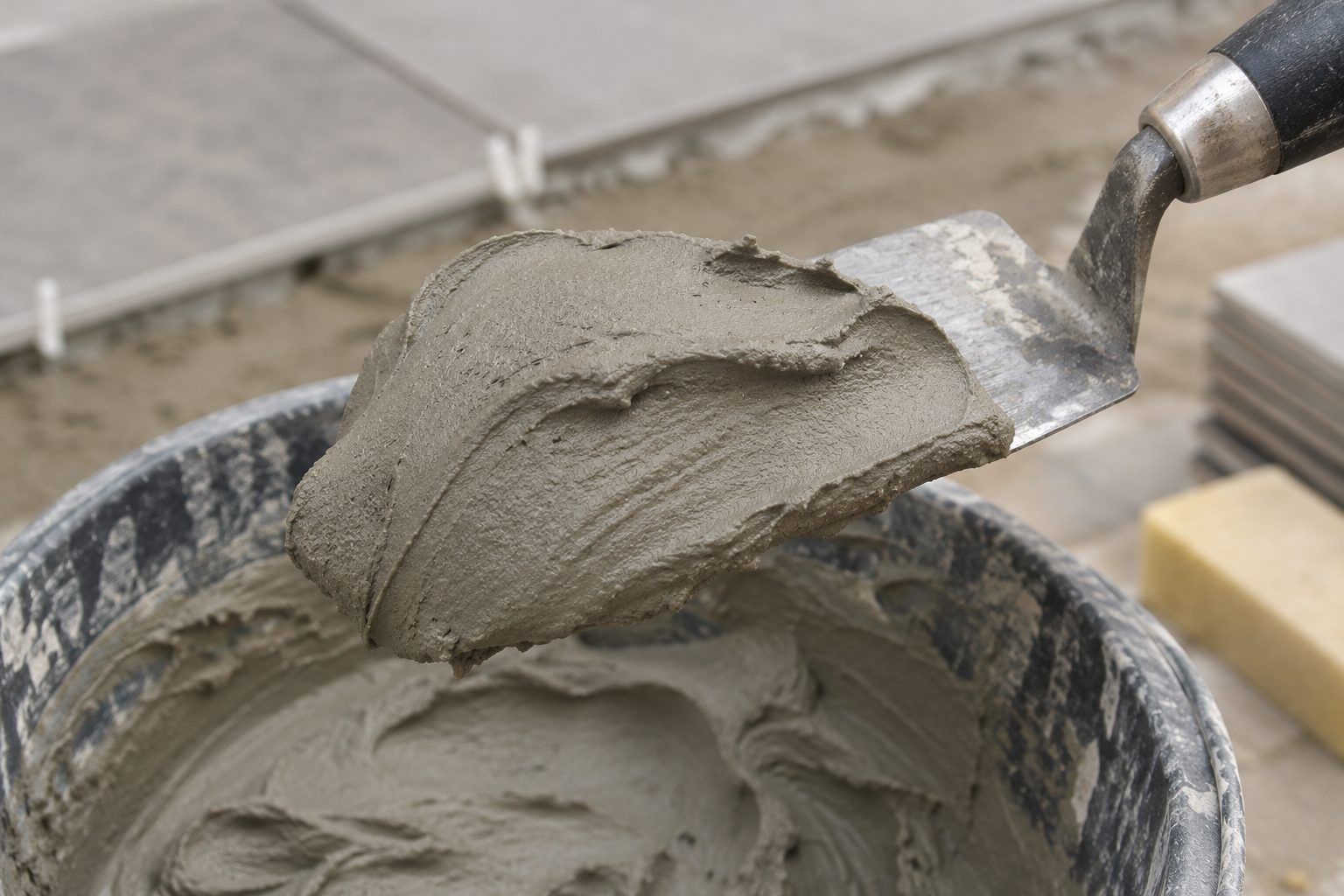
A correct mix holds its shape on the trowel. It packs into the joint without slumping back out. It is a thick paste, not a pourable batter. If it runs or drips, there is too much water. Start again rather than add powder to a wet mix, which rarely disperses evenly.
For epoxy, the feel is different. It is denser and more paste-like, and the judge of a good mix is uniformity rather than stiffness. No streaks, no dry powder, no soft pockets. One colour throughout.
The consistency also depends on getting the grout into the right width of joint. Unsanded cement grouts are made for narrow joints, usually 1 to 3 mm, while decorative and wide-joint grouts cover a broader range. Match the grout to the joint before you mix, and work out quantity with the joint filler calculator so you mix the right amount.
When to use an admix instead of water
There is a third option for cement grout that is worth knowing. Instead of gauging the powder with water, you gauge it with a polymer admix.
A polymer admix, such as KGA-01, replaces the gauging water at the same ratio. The brand states the result is a denser, more colourfast joint that keeps moisture from getting in through the joints. It does not stop damp coming from the wall or floor behind the tile. That needs a proper waterproofing system under the tiles. It is not an additive you pour in on top of water. It takes the place of the water entirely.
Stir the admix thoroughly before you use any of it, because polymer liquids settle and an unstirred container gives an inconsistent first batch. Then mix exactly as you would with water. A denser joint earns its place in wet areas, on pale grout and on exterior work.
Mixing mistakes that weaken the joint
The same handful of errors account for most failed joints, and all of them happen at the mixing stage.
Too much water tops the list. It feels easier to work, so people add a little extra, and the joint pays for it with powdering and colour loss, a common route to the grout water damage seen in bathrooms. Re-tempering is next: adding water to a mix that has started to stiffen, which restores the look and none of the strength. If a batch has gone off, discard it.
Part-mixing an epoxy pack throws the resin-to-hardener ratio and leaves joints that stay soft. Combine both liquid parts in full, every time. Mixing too much at once is the epoxy trap specifically, because the clock is running from the moment the parts meet. Mix less than you think you need.
Then there is the cleaner you choose later. Acidic cleaners can damage cement grout, causing colour change, cracking and powdering, so the joint you mixed carefully should never meet an acid cleaner later. For marble and natural stone nearby, a non-acidic cleaner is the safe choice.
One last point that no mix can fix. Cement grout is rigid and cannot accommodate movement, so movement joints still need a flexible sealant rather than grout, however well you mixed it.
Quick checklist before you mix tile grout
- Cement or epoxy? The method is completely different.
- Does the grout suit your joint width? Narrow joints need an unsanded cement grout.
- Measured your liquid? 375 to 400 ml per kg for cement grout.
- Water or admix? Admix replaces water, never adds to it.
- Powder into liquid, not liquid onto powder.
- Mixed to smooth and stiff, holding its shape?
- Substrate within the temperature range printed on the bag?
- Mixing only what you can place and clean in time?
Frequently Asked Questions
It depends on the type. For cement grout, use 375 to 400 ml of water or admix per kilogram of powder, add powder to liquid, and mix to a smooth, stiff paste. For epoxy grout, combine the two liquid parts first, then add the filler powder, with no water at all.
It is a set amount of liquid per kilogram of powder, printed on the bag. For Gresbond's cement grout it is 375 to 400 ml of clean water or polymer admix per 1 kg. Measure the liquid rather than judging it by eye, so the colour sets consistently across the floor.
No. Epoxy grout such as KE-100 is a multi-part system of two liquid components plus a filler powder. Water is not part of the mix and will interfere with the cure. Combine the liquids first, then add the powder.
Cement grout should be smooth and stiff, holding its shape on the trowel rather than running off it. Epoxy grout should be uniform and lump-free throughout, with no soft pockets or dry powder.
No. Re-tempering a stiffening mix with water restores the appearance but not the strength, and leaves a joint that fails early. If a batch has started to go off, discard it and mix a fresh one.
Usually because the two liquid parts were not fully combined, or the pack was only part-mixed, which disturbs the resin-to-hardener ratio. Both components must go in completely and be scraped from the sides of the container.
An admix such as KGA-01 replaces the water and gives a denser, more colourfast joint that keeps moisture from getting in through the joints. It is not a substitute for waterproofing the substrate. It is worth it in wet areas, on pale grout and on exterior work. In a dry interior with dark grout, water is often enough.
Still have questions? Contact our technical team