Tile Adhesive Specifications: IS 15477 Classification Guide
Gresbond by Kajaria Editorial Team
November 28, 2026
IS 15477:2019 is the Indian standard that classifies tile adhesive, yet most buyers never learn to read it. This guide covers what it says, how the five types differ, what ISO 13007 codes like C2TES1 mean, and how to match a type to the job.
A tile adhesive bag carries a code that tells you exactly what the product can do, and almost nobody reads it. IS 15477 is the Indian standard behind that code. Learn to read it and you can tell, before buying, whether a grade suits a bathroom floor, an exterior wall or a gypsum board partition. Ignore it and you are trusting a word like premium on the front of the bag, which means nothing on its own.
This matters most for architects, specifiers and contractors writing a material into a project, where getting the classification wrong is an expensive mistake to unpick later. But it helps any serious buyer. This guide explains what the standard covers. It shows how the classification works, what codes like C2TES1 mean, and how to match a grade to the job.
Key Takeaways
- IS 15477:2019 is the Indian standard for ceramic, mosaic and stone tile adhesive.
- It sorts adhesive into five types by the tile, the surface and the location, each with minimum bond strengths.
- Type 1 is for interior dry areas only. Type 5 is the resin type for metal, glass and dry wall boards.
- A higher type is not always better. The ISO 13007 code (like C2TES1) runs alongside it.
- T means slip of 0.5 mm or less. S1 and S2 mean deformability. Each suits specific jobs.
- A printed classification points to a defined benchmark. A marketing word does not. Ask for the test documents.
- Always confirm the exact grade and code on the product page or TDS.
What IS 15477:2019 actually covers
IS 15477 is the Bureau of Indian Standards specification for adhesives used to fix ceramic, mosaic and stone tiles. It covers vitrified and non-vitrified ceramic, porcelain, clay, glass, glass mosaic, metal, natural stone and engineered stone tiles. In plain terms, it sets the rules an adhesive must meet to call itself a grade. It also defines how those grades are tested and labelled. That is the point.
The value of it is simple. A printed IS 15477 classification points to a defined benchmark, and the test report or certificate is how you confirm it. A manufacturer who writes only superior bonding strength has given you nothing to check. For anyone specifying a material into a building, that difference is the whole point of the standard.
Amendment 1, issued in September 2024, rewrote the type definitions, and this guide follows the amended text. Gresbond states IS 15477 classifications on its grades where they apply, and lists them on the standards and certifications page alongside the product TDS documents.
How IS 15477 classifies tile adhesive
The standard sorts tile adhesive into five types. Each is defined by the tile it suits, the surface behind it and where it goes. Knowing them is what lets you match a grade to a job.
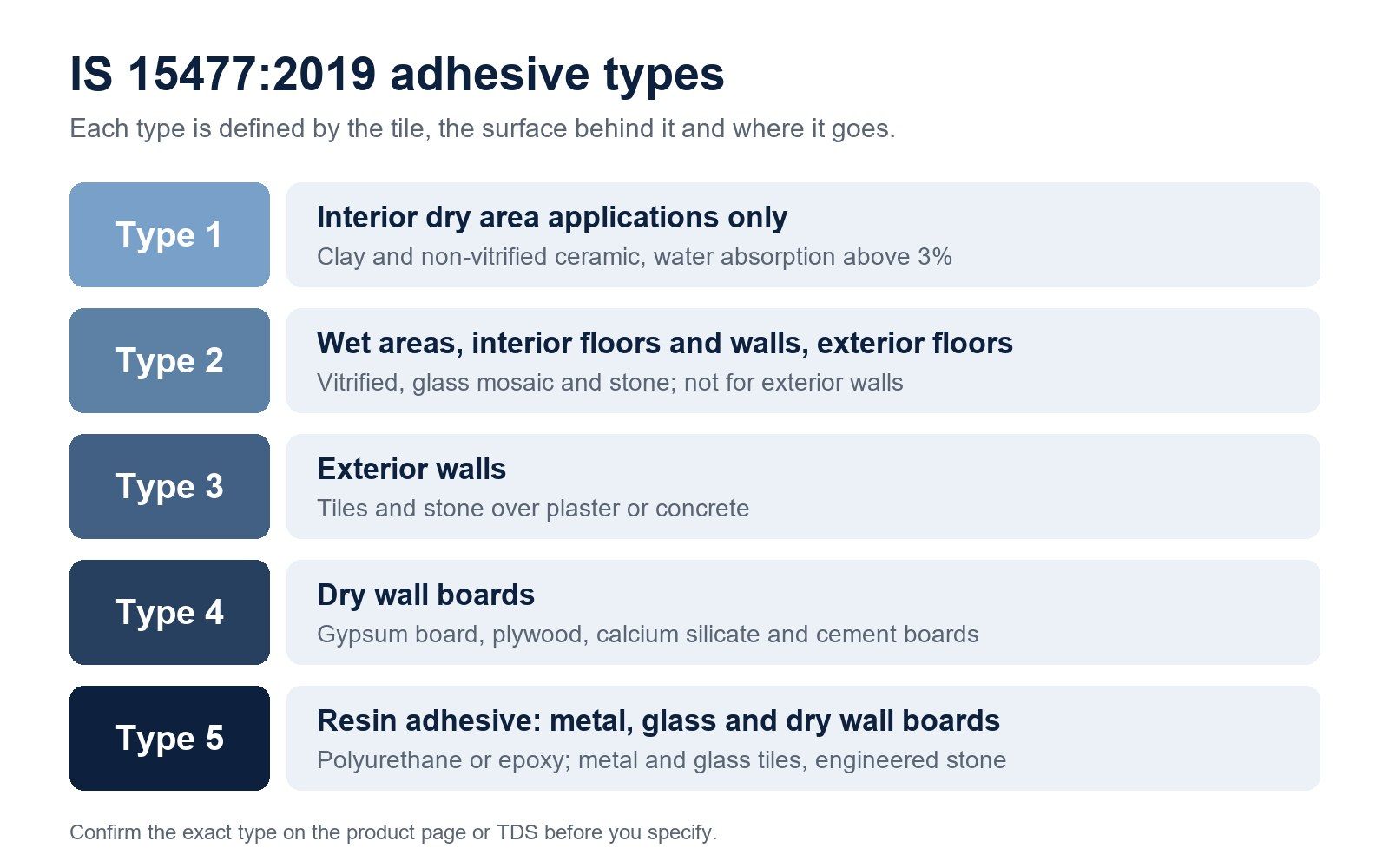
Types 1 to 3 are for cement-based surfaces such as plaster, concrete and screed. Type 4 moves to dry wall boards. Type 5 is a different chemistry: a resin adhesive that hardens by chemical reaction.
The five types in short:
- Type 1: tiles with water absorption above 3%, such as clay and non-vitrified ceramic up to 600 × 300 mm. For interior dry area applications only.
- Type 2: tiles with water absorption of 3% or less, such as vitrified tiles, glass mosaic and stone up to 600 × 600 mm. For wet and submerged areas, interior floors and walls, and exterior floors. Not for exterior walls.
- Type 3: tiles and stone on exterior walls over plaster or concrete.
- Type 4: tiles on dry wall boards such as gypsum board, plywood, calcium silicate and cement boards. Tiles over 600 × 600 mm also need S1, and over 1200 × 1200 mm need S2.
- Type 5: resin adhesives, such as polyurethane or epoxy, for metal or glass substrates, metal and glass tiles, engineered stone, and dry wall boards.
The minimum bond strengths rise with the type as well. Dry tensile adhesion starts at 0.5 N/mm² for Type 1 and reaches 2.0 N/mm² for Type 5.
A higher type is not automatically the right choice. It is about fit. The types are not a simple ladder. An interior ceramic wall does not need an exterior wall grade. Paying for one is waste. Keep it simple. A vitrified pool surround, on the other hand, needs at least Type 2, because it is a wet and submerged area. Matching the grade to the project is the skill. It is not hard.
What the ISO 13007 codes mean
Alongside the IS classification, an adhesive may carry an ISO 13007 code. It looks cryptic until you break it apart. Take C2TES1, which is the code on one of the Gresbond exterior grades.
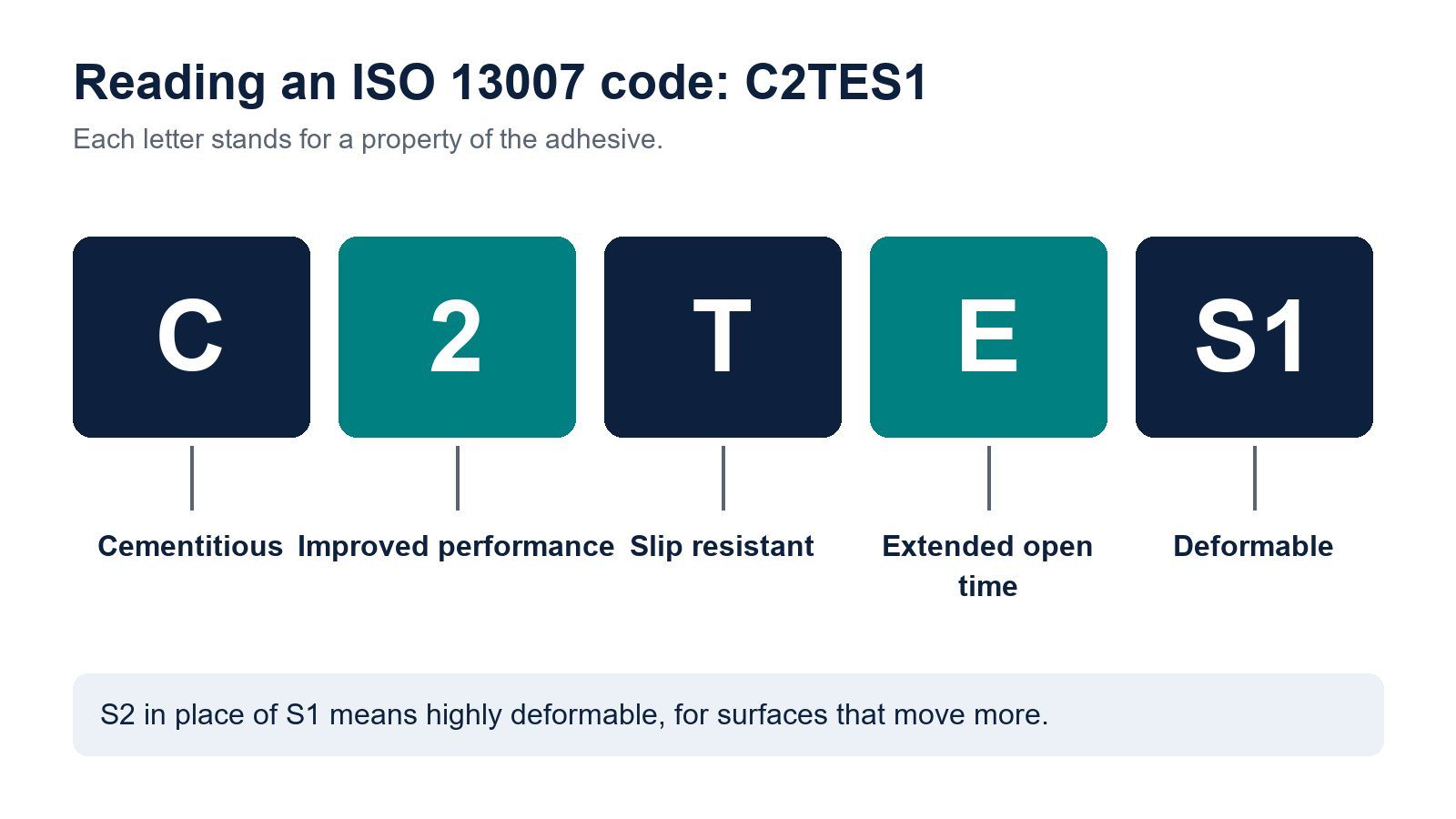
The C means it is cementitious. Simple. The 2 means improved performance rather than basic. The T means it is slip resistant, so a tile does not slide down a wall before it sets. The E means extended open time, giving you longer to place the tile before the bed skins over. The S1 means it is deformable, so it can take a degree of movement in the surface beneath without failing. IS 15477 itself uses only the T, S1 and S2 markers on its type number, as in Type 2T or Type 4TS2.
An S2 in place of S1 means highly deformable, for surfaces that move more. In the IS 15477 test, S1 bends more than 2.5 mm and under 5.0 mm, and S2 more than 5.0 mm. T means the tile slips no more than 0.5 mm. A code is not decoration. Each letter stands for a property, and reading it tells you what the adhesive is built to handle.
Matching an IS 15477 type to the job
This is where the standard becomes a buying decision. Take the type for your job, then check which grades in a range carry it.
As examples, Gresbond's white VX-2 conforms to IS 15477:2019 Type 2T for low-porosity tiles and light stone, though it is not for mesh-backed tiles and stones. EX-5 exceeds Type 3TS1 and is classified C2TES1 under ISO 13007, for tile-on-tile work, vitrified tiles, natural stone and glass mosaics.
For large formats and surfaces that move, LX-7 Super Flex carries IS 15477:2019 Type 4TS2 and C2TES2. Type 4 is the dry wall board type, and S2 is what the standard asks for with the largest tiles. State only the classification a product actually carries. Confirm the exact code on the product page or TDS before you write it into a specification. The published figure is the one that counts.
How to read a bag before you specify
Put it together and a bag becomes readable at a glance. It takes a minute.
Find the IS type first. It shows the tile, surface and location the adhesive is meant for. The standard requires each bag to carry it, along with the month and year of manufacture, batch number, open time and storage life. Find the ISO 13007 code to read the specific properties, letter by letter. Check both are printed. A marketing phrase does not count. Move on if neither is there. Then match that against the job: the tile, the substrate, whether it is wet or dry, interior or exterior, and how much the surface is likely to move. Our wall tile adhesive selection guide and the tile adhesives range show how that works in practice.
Where a grade prints no classification, do not assume one. Ask. Check its TDS in the TDS library for the tested figures. A missing code is not a small print detail. It leaves you with nothing to check.
Quick specification checklist
- Is an IS type actually printed on the grade?
- Is there an ISO 13007 code, such as C2TE or C2TES1?
- Does the type match the job, rather than simply being the highest available?
- Does the tile need the slip resistance the T denotes?
- Does the surface move enough to need S1 or S2 deformability?
- Is it a wet area, an exterior wall or a board or metal surface? Each points to a different type.
- Have you confirmed the code on the product page or TDS?
Frequently Asked Questions
It is the Bureau of Indian Standards specification for adhesives used with ceramic, mosaic and stone tiles. It defines how tile adhesives are classified and tested, so a printed classification is a benchmarked claim rather than marketing language.
It is the recognised Indian standard for classifying tile adhesive. A stated classification tells a specifier the product was tested against a defined benchmark. Always confirm the exact grade and code on the product documentation.
Under ISO 13007, C means cementitious, 2 means improved performance, T means slip resistant and E means extended open time. It describes a set of properties, not a brand claim.
Both describe deformability, which is how much movement the set adhesive can take. S1 is deformable and S2 is highly deformable, for surfaces that move more. In the IS 15477 test, S1 deflects more than 2.5 mm and under 5.0 mm, and S2 more than 5.0 mm.
No. The right grade matches the job. A Type 1 grade suits small ceramic tiles in an interior dry area, while an exterior wall needs Type 3. Over-specifying wastes money without improving the result.
It is the resin type in IS 15477:2019, such as a polyurethane or epoxy adhesive that hardens by chemical reaction. It suits metal and glass substrates, metal and glass tiles, engineered stone, and dry wall boards such as gypsum board and plywood.
On the product packaging and documentation. The standard requires each bag to show the type and any T, S1 or S2 marking. For Gresbond grades, the classifications appear on the product pages, the standards and certifications page, and each grade's TDS. Confirm the code there before specifying.
Still have questions? Contact our technical team